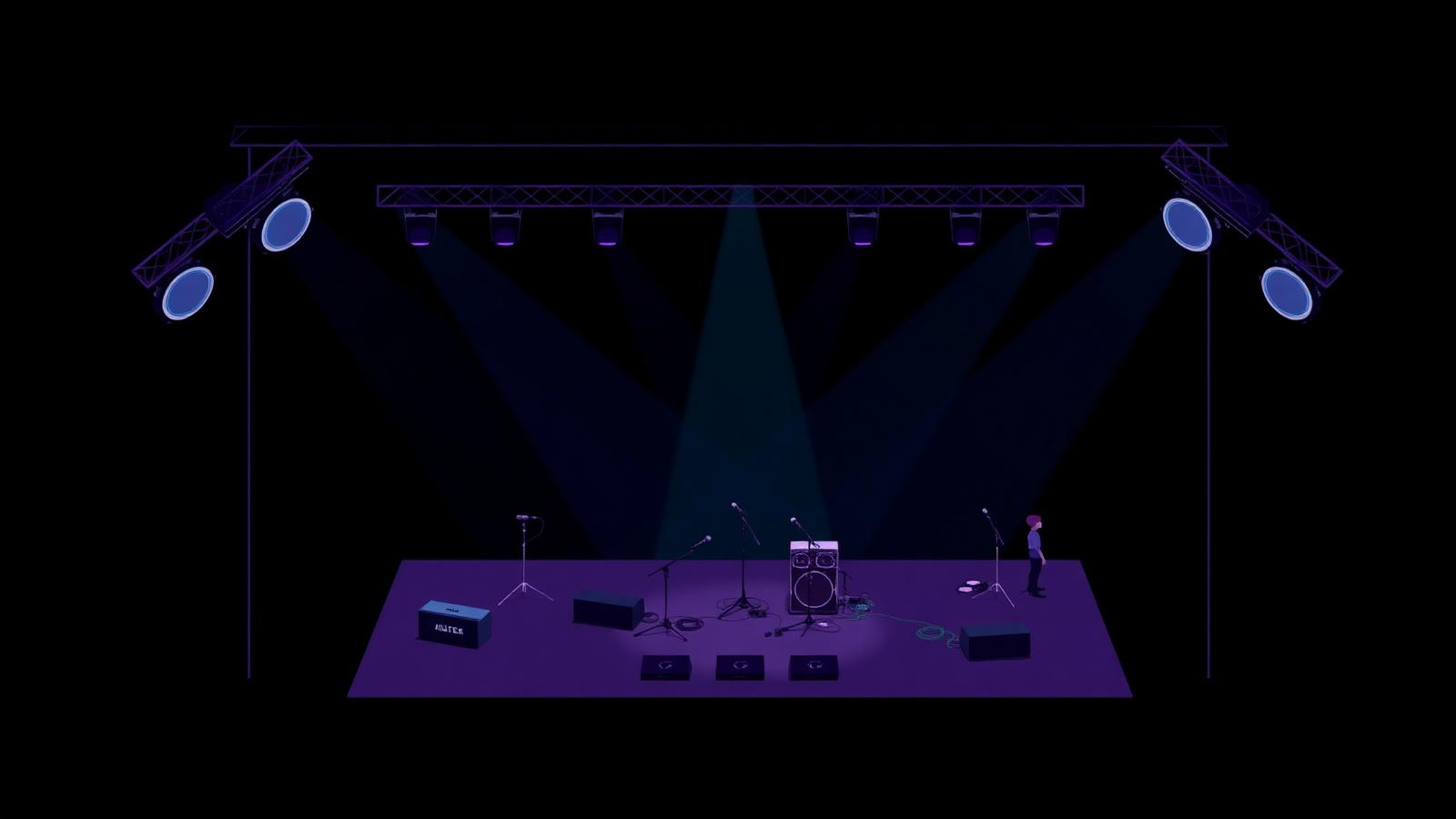
The document behind every good show
Ask any experienced sound engineer what separates a smooth load-in from a stressful one, and the answer is almost always the same: whether the artist sent a clear stage plot.
A stage plot is not decoration. It is not a nice-to-have. It is the single technical document that tells everyone — the house engineer, the monitor tech, the lighting designer, the stagehand pushing risers into place — where things go, what they need, and how the show is meant to work on their stage.
When it is right, nobody notices. When it is wrong or missing, everyone pays for it in minutes lost and tempers frayed.
What a stage plot actually is
A stage plot is a top-down diagram of the performance area. It shows the physical position of each performer, their instruments, amps, microphones, monitor wedges, DI boxes, keyboard risers, backline and power drops. Alongside it — usually on the same page or paired with an input list — it communicates the technical requirements of the show.
It is a communication tool, not an art project. Its purpose is to remove ambiguity. A house engineer looking at a good stage plot should be able to answer, in under thirty seconds:
- Where does each performer stand?
- How many microphones, DIs and monitors are needed?
- Where do the cables and power drops go?
- What backline is the artist bringing, and what does the venue need to provide?
If a plot cannot answer those questions quickly, it is not doing its job.
Why venues and festivals ask for it
Every venue that runs professional shows requests a stage plot in advance. It is not a formality. The technical crew uses that document to prepare the room hours — sometimes days — before the artist arrives.
The monitor engineer patches wedges to the right sends. The FOH engineer preloads a rough mix. The stagehands mark tape positions on the deck. The lighting designer roughs in front and back positions for each performer. All of that work happens before the artist walks through the loading door.
Without a stage plot, none of that preparation is possible. The crew has to guess or wait. Load-in becomes a series of interruptions — "Where does the drummer sit?", "How many vocal mics?", "Who needs a wedge?" — and every one of those interruptions costs minutes that the schedule does not have.
The real cost of a missing plot
Consider a few situations that happen every week in venues around the world:
Missing monitor positions
A four-piece band arrives without indicating where their monitor wedges should sit. The monitor tech places them in a standard pattern. During soundcheck, the guitarist realises they cannot hear the vocalist — the wedge is aimed at where a keyboard player would stand, not where they actually perform. Fifteen minutes disappear repositioning wedges and re-ringing them out.
Incorrect instrument placement
A stage plot shows a keyboard rig stage-left, but the keyboardist actually performs stage-right. The backline is set up in the wrong position, the DI runs are on the wrong side, and cables have to be re-run under an active drum kit while the next act is trying to line-check.
Forgotten power outlets
The plot shows five performers but does not mention that three of them need dedicated power drops for keyboards, pedalboards and in-ear systems. The venue is running on a limited stage power layout and now has to pull extra distros before doors open.
Stage size limitations
A festival plot is drawn as if the stage is infinite. The actual performance area is nine metres wide. Risers do not fit. The drum kit cannot go where the plot places it. The stage manager has to redesign the layout in real time, on the deck, while a changeover clock ticks down.
Festival quick changeovers
At a festival with twenty-minute changeovers between acts, there is no room for improvisation. The crew has read every stage plot in advance and pre-set as much as possible on rolling risers. An artist whose plot is unclear or contradicts their input list forces the crew to stop, re-check and re-patch — and the next act starts late.
None of these situations are dramatic on their own. They are just friction. But friction compounds. Three small confusions in a row is a delayed set. Five is a bad show.
The communication problem a stage plot solves
Most touring artists work with different local crews every night. The house engineer at Tuesday's venue has never met them. Neither has the monitor tech, the stagehand, or the lighting operator. There is no shared history to fall back on.
A stage plot is the substitute for that shared history. It is how an artist says, "This is how our show works," to a room full of strangers, without a long conversation.
When it is clear, the local crew reads it once and knows what to do. When it is vague, they have to ask questions — and every question is a small tax on the time and attention of people who are trying to help the artist look good.
How engineers actually use it
For a house engineer, the stage plot is one half of a pair. The other half is the input list — the numbered list of every microphone, DI and line source the artist needs, in the order they should be patched.
Together, those two documents tell the engineer everything they need to prepare:
- How many channels to allocate at FOH and monitors
- Which microphones the venue needs to provide
- How many DIs are required
- Which performers need in-ear monitors versus wedges
- Where cables need to run
- What backline needs to be sourced
A good plot lets the engineer preload a session, prep a stage box and rough in a monitor mix before the artist opens a case. A vague plot means all of that work happens live, under pressure, in front of a soundcheck clock.
Why touring artists cannot afford to skip it
For touring artists, the stage plot is not a per-show document. It is a piece of infrastructure. The same plot goes to every venue on the tour, weeks in advance, and it sets the expectation for every stage the artist walks onto.
If it is professional, the tour is treated professionally. Venues take it seriously. Festival production managers slot it into their prep. Crews trust the information and work to it.
If it is a rough sketch — a phone photo of a napkin, a paint drawing with no labels — the tour is treated with the same care. Venues chase the artist for clarification. Prep is delayed. The first day of the tour becomes a series of small conflicts that could have been resolved on paper.
The document sets the tone before anyone in the crew has even met the artist.
Why small bands benefit from one too
There is a persistent myth that stage plots are only for touring acts and festival headliners. In practice, the opposite is true: smaller acts benefit even more.
An emerging band playing a 200-cap room usually gets fifteen minutes for a line-check, not a full soundcheck. Every minute of that fifteen matters. A clear stage plot means the engineer already knows what to expect and can move directly to setting levels. No plot means the first five minutes disappear into orientation.
A stage plot is also how smaller artists signal that they are serious. Venues, promoters and festival buyers notice. Being easy to work with is one of the most underrated forms of career capital in the live industry, and a clean stage plot is one of the clearest ways to show it.
Where digital stage plots change the picture
For years, artists made stage plots in whatever tool was handy — a drawing app, a slide deck, a paint program, sometimes literal pen and paper photographed with a phone. The result was a static PDF that was out of date the moment the lineup changed, the drummer swapped kits or a keyboard was added to the show.
Digital stage plots solve that. When the plot lives in one place, updates are instant. Every venue and every engineer sees the current version, not last year's. Changes to the input list flow through automatically. A single link replaces a folder full of conflicting PDFs.
This matters most when things change close to the show — a stand-in musician, a swapped instrument, an added guest. In a static-PDF workflow, those late changes are either communicated by email and forgotten, or captured in a new file that half the crew never sees. In a live document, they are just there.
Stage plots as part of a bigger picture
A stage plot on its own is useful. A stage plot connected to the rest of the production — input list, hospitality rider, technical rider, day sheet, contact list — is transformative. It stops being a document and starts being part of how the show is run.
This is where a tool like ArtistRider fits in. It is where the stage plot, technical rider, input list and rest of the production information live as one connected document that every party can read from the same source. No re-sending, no version confusion, no "which PDF is current". Just one place that is always right.
Artists who work this way spend less time managing files and more time on the show. Crews who receive it spend less time chasing clarifications and more time preparing. That is the shift.
The bottom line
A professional stage plot is not a formality. It is the shortest, cheapest, most effective piece of production infrastructure an artist can invest in. It saves setup time on every show. It prevents the small confusions that turn into big delays. It signals professionalism before the artist has walked into the room.
Every artist — from the emerging four-piece playing their first support slot to the international headliner at a festival — benefits from taking it seriously.
The stages you play on are different every night. The document that makes them all work should not be.