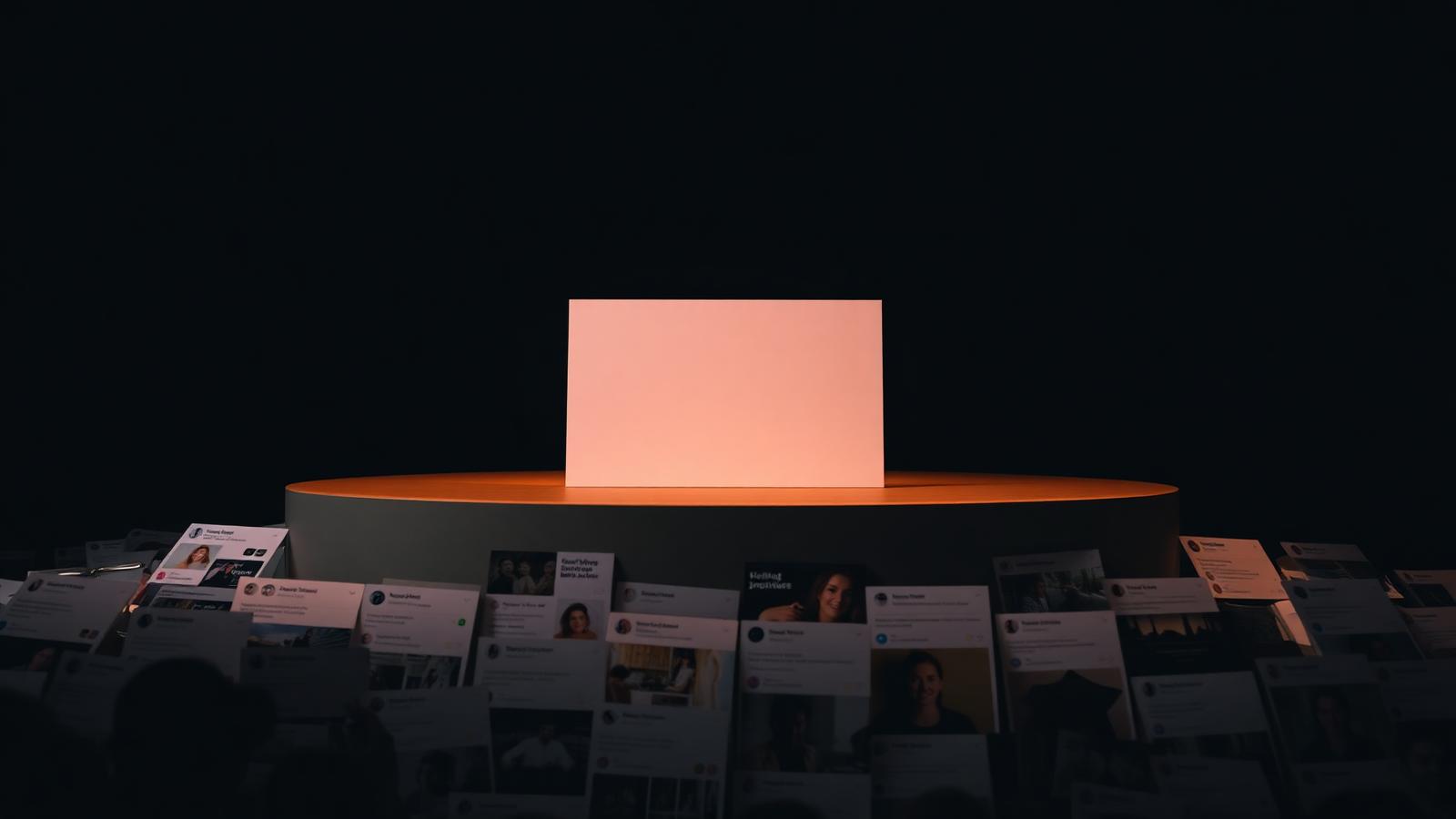
Somewhere in the industry, right now, is the exact collaborator you need. The producer whose sound matches your project. The tour manager who has done your route before. The support act whose energy would complete your festival. They exist. They are working. They are — in the deepest sense — findable in principle.
And yet you have not found them, and they have not found you. Not because either of you is failing. Because the industry has no reliable mechanism for the two of you to meet.
The industry does not have a shortage. It has a discovery gap.
The conversation about opportunity in live music tends to focus on scarcity: too few slots, too much competition, saturated markets. But if you spend time inside the sector, a stranger pattern emerges. The gaps are not really about supply. They are about matching.
- Festivals routinely rebook the same 30 support acts within a genre while dozens of appropriate acts nearby remain uncontacted.
- Touring artists cycle through a small pool of tour managers and technical crew, while capable people wait for a break in an adjacent city.
- Promoters develop a shortlist of "safe" collaborators, not because that shortlist is the best available, but because it is the known available.
- Venues run the same production companies for years, not out of loyalty, but out of the friction of finding alternatives.
The industry is not short of opportunity. It is short of discoverability.
Why the current stack cannot fix this
Discovery in most industries is a solved problem. You search, you filter, you contact, you verify. In live entertainment, none of those verbs behave the way they should.
Search happens in Facebook groups and DMs, which surface who shouted loudest, not who fits best.
Filter does not exist. You cannot narrow a list to "lighting designer, festival-experienced, based within 500km, available in August, English + Hungarian."
Contact is either warm — via mutual acquaintance — or cold and low-response, via generic messaging platforms.
Verify happens by asking around, which takes days, and only works if the person asking already knows enough people to triangulate a reference.
Each of these steps is a bottleneck. Together, they mean that most collaborators find each other through a mixture of luck, proximity and reputation — not through any structured search.
When discovery is expensive, the industry defaults to what is familiar. That is not a taste choice. It is a cost choice.
The costs no one names
The hidden opportunity gap costs three things at scale.
1. Loss of the best-fit
Every time a promoter books a familiar support act rather than a more appropriate one, the audience gets a slightly worse show. Multiply this over a season, and the aggregate quality of the industry's output drops in ways nobody measures.
2. Career blockages
Talented professionals plateau not because their work stops improving, but because they run out of people who can see them. Their skill grows; their surface area does not.
3. Cultural narrowing
When discovery is bad, the same sound, the same route, the same lineup shape keeps recurring. Not because organisers lack imagination, but because imagination without infrastructure cannot travel far.
Trust as the missing infrastructure
The reason the general internet has not solved this is that music-industry discovery is not really a search problem. It is a trust problem. Booking someone you have never worked with is a risk. The risk is not just financial; it is reputational. If a support act underdelivers, the audience remembers the festival, not the act.
That is why the industry falls back on personal networks — because personal networks carry trust. General platforms do not.
A discovery layer that works for live music has to carry trust the way personal networks do — but at a scale that personal networks cannot. That is a specific design problem, and it is not solved by search bars.
What a discoverable industry would look like
Imagine an industry where:
- Every professional has a structured profile that reflects real work, not marketing polish.
- Availability is expressed in a way that machines and humans can both read.
- References are attached to specific projects, dated, and mutually visible.
- Search can filter by role, geography, language, past collaborators and technical familiarity.
- Contact happens inside a professional channel where response rates are higher because context is richer.
- A newcomer without personal connections can enter with credentials that grow through their actual work.
None of this replaces the human warmth of the industry. All of it makes the human warmth reach further.
Practical recommendations
Even before infrastructure catches up, three habits shift outcomes.
- Describe yourself in the industry's language. Not "passionate about music" — actual roles, actual projects, actual references.
- Ask for a structured reference after every project. "Would you write two sentences about our work together?" Two sentences, timestamped and named, are worth more than a hundred generic reviews.
- Look outside your default circle. Every festival, tour and season, deliberately explore one contact you would not normally have made. Discovery is a muscle.
Discoverability as a strategic asset
For promoters, agencies and festival directors, the argument is even stronger. In a saturated market, the ability to find the right collaborator faster than competitors is a durable operational advantage. It compresses booking cycles, reduces the cost of vetting, and expands the range of options available.
Discoverability is not a nice-to-have layer on top of the industry. It is the missing infrastructure underneath it.
Where Startion fits
Startion's Bandland workflow app is built as the discoverability layer the live entertainment industry never had. Structured professional profiles, verified project histories, availability signals, role-aware search and trust that carries across projects — all designed for how live entertainment actually operates, not adapted from a corporate or social platform.
Bandland does not replace the industry's personal networks. It amplifies them, so that the right people finally find each other on purpose, not by accident.
Your next opportunity is not missing. It is simply unindexed. That is a fixable problem.